
How this guide works
The most useful Christmas activities are not the busiest ones; they are the choices that match the people who are actually present. Start with group size, available energy, desired social contact, time, setting, cost, and cleanup. Then choose one activity and name a complete lower-pressure fallback before anyone begins. Watching, listening, helping with one step, taking a break, leaving early, or declining all count as participation.
This selector covers ten broad seasonal options rather than ten obligations. It does not promise that a venue, route, product, platform, volunteer opening, or format will suit a particular person. Ask participants what would help, confirm current details with the responsible source, and keep the easiest swap genuinely available. For detailed rule-based play, use the separate Christmas party games guide; this page owns activity fit rather than game instructions.
Choose by demand before choosing by theme
Use the Matrix in four passes. First, choose a participant band that fits the space without treating the number as a capacity guarantee. Second, select a physical and social demand that feels realistic today. Third, check the setting dependencies: weather, transport, lawful media access, product labels, host permission, or venue information. Fourth, confirm the cleanup owner and the complete swap. A 20-minute quiet table may be a better match than a two-hour outing even when both sound festive.
For an outdoor walk, consult the current National Weather Service winter resources and local forecast shortly before leaving. Recheck surfaces, visibility, lighting, transport, the return point, and participants’ preferences. A warning, unsafe surface, uncomfortable conditions, or uncertainty ends the outdoor plan; it does not start a debate. The indoor photo-tour swap should be ready before the group meets.
Do not describe an uninspected place as accessible. The 2010 ADA Standards explain accessible-route requirements for covered sites, but they do not certify the neighborhood or venue in front of you. Ask the responsible operator about entrances, surfaces, curb transitions, distance, seating and rest options, restrooms, lighting, and transport, then let each participant decide whether the available information fits them.
Ten ways to use the selector
The playlist hour is the lightest shared-audio option. The film matinee creates a longer, quieter block with a clear pause and exit plan. The recipe exchange keeps food memories conversational, without requiring cooking, tasting, or dietary disclosure. The one-photo story hour adds context before asking for a response. The decoration walk is the only outdoor choice and therefore has the firmest weather and route gate.
The card table works for people who prefer parallel activity over group discussion. The craft hour points to a bounded project instead of repeating instructions; the CPSC Art and Craft Safety Guide remains the source boundary for labels, tools, workspace, ventilation, storage, and cleanup. The puzzle table removes timing and competition. The book exchange allows browsing, listening, or passing. The volunteer or appreciation action begins only after a current host confirms the need and rules through a listing such as Volunteer.gov or its own official channel.
If the season is not the right organizing frame, the fall activities selector compares a wider range of autumn days, while the rainy-day activities guide starts with indoor energy. Those pages retain their own evidence and scope. Their inclusion here does not transfer safety, suitability, access, weather, supervision, or outcome claims.
Keep participation optional and specific
A useful invitation names what will happen, how long it may take, where it will happen, and how someone can participate quietly. Instead of saying everyone will take turns telling a story, say that four permission-cleared photos will be available and people may share, listen, or pass. Instead of promising a fully accessible walk, provide the verified route facts and the indoor alternative. Avoid asking anyone to explain a disability, sensory preference, family history, budget, or reason for leaving.
For mixed ages, assign supervision and tool control before the activity, not after supplies appear. A child, older adult, or disabled participant is not a single ability category. Ask concrete questions about seating, reach, lighting, sound, reading format, breaks, transport, and whether help is wanted. If the answers are incomplete, choose the low-demand indoor version. Product labels, caregivers where relevant, venue rules, and participant choices remain controlling.
For music, films, books, and read-alouds, use a lawfully obtained copy or authorized service and follow the current terms. The U.S. Copyright Office Fair Use FAQ explains that fair use is circumstance-specific and gives no fixed safe amount; some entertainment performances in institutional or public settings may require permission. This page supplies no legal clearance and reproduces no lyrics, pages, cover art, or film frames.
Plan the fallback as part of the activity
A fallback is complete only when it uses available space and supplies, asks less of participants, and can begin without a new purchase or argument. The walk swaps to an indoor photo tour. A full film swaps to one short authorized program. A craft swaps to folding pre-cut paper. A large puzzle swaps to a lower-piece-count puzzle or color sorting. A volunteer visit swaps to a host-approved remote or appreciation action, or to a different indoor choice when no current host need is confirmed.
Put one person in charge of the time check and one person in charge of cleanup, while allowing both roles to be declined and reassigned. Keep walkways clear, protect addresses and private photos, return borrowed books, count craft tools, and store puzzle pieces before changing activities. Cost bands are planning estimates: free means no new purchase is expected, not that transport, data, postage, subscriptions, materials, or admission can never add a cost.
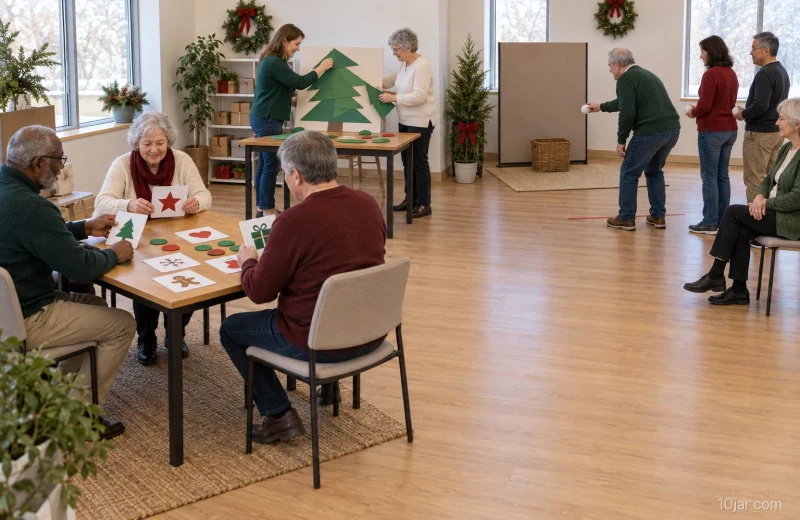
The ten directions and the Activity Energy/Group-Size Matrix are independently desk-developed editorial. They are not documented 10jar events, route or venue inspections, participant tests, price surveys, legal reviews, or outcome studies. The generated scenes illustrate the planned setup; a scene cannot prove access, safety, permission, availability, enjoyment, or fit for a particular group.
Sources, checks, and refresh boundary
Check the five linked official sources in the context where they apply, then verify the current local detail. Weather and route conditions can change within hours. An operator can change access information or a schedule. A host can close a volunteer listing or alter eligibility and supplies. A platform can change terms. A product label can control a craft material more narrowly than this selector. When a controlling fact changes, use the swap instead of stretching the original plan.
Review this guide annually before the Christmas season and sooner after a source, route, venue, activity, owner, Matrix field, cost or time estimate, schedule, image, or substantiated correction changes. The goal is not to maximize activity. It is to make one clear invitation, preserve real choices, and stop while the group still has the energy and consent to finish cleanup.
On this page
- Choose-together holiday playlist hour
- At-home film matinee with opt-in seating
- Family-recipe memory exchange without cooking
- One-photo story hour with context first
- Short neighborhood decoration walk
- Card-writing or thank-you-note table
- Shared low-risk craft hour
- Untimed collaborative puzzle table
- Book exchange or optional read-aloud
- Verified volunteer or appreciation action
1Choose-together holiday playlist hour
Plan a 35-to-60-minute indoor listening block for two to eight people. Before gathering, create a blank shared queue with space for 12 to 18 selections, confirm a lawful music source, choose a moderate starting volume, and name one person who can adjust or stop playback. Invite each person to suggest a selection privately, aloud, or not at all; nobody has to explain a pass. Do not print or display lyrics. Pause after about 25 minutes to ask whether the volume, pace, or activity should change. Allow about 10 minutes for setup and five for closing the queue and clearing cups or papers. The quiet fallback is a pre-agreed instrumental queue with listen-only participation.
- Why it stands out
- It creates a shared atmosphere without requiring eye contact, movement, performance, or continuous conversation.
- Best for
- Two to eight people who want low physical demand and adjustable social contact indoors.
- Good to know
- Subscriptions, data access, speaker placement, hearing preferences, and platform terms may change the practical fit.
2At-home film matinee with opt-in seating
Set up a 90-to-135-minute at-home matinee for one to eight people using a lawfully obtained copy or authorized service. Confirm the running time, current platform access, seating, room temperature, lighting, captions or audio description when the chosen source provides them, and a clear path to exits and breaks. Offer four flexible seating zones rather than assigned seats, and state that pausing, moving, watching briefly, or leaving early is acceptable. Keep snacks optional and separate from the activity so food needs are not assumed. Allow about 15 minutes to set the room and 10 minutes to restore it. The fallback is one short authorized program with the same pause and exit choices.
- Why it stands out
- A clear pause plan turns a long passive activity into a flexible block people may enter or leave.
- Best for
- A small indoor group seeking very low physical demand and limited required conversation.
- Good to know
- A home viewing plan does not provide public-performance clearance for a school, business, club, or venue.
3Family-recipe memory exchange without cooking
Invite two to ten people to a 30-to-50-minute conversation using one optional recipe card, kitchen object, or remembered meal prompt per person. Make clear before the gathering that no cooking, tasting, dietary disclosure, family-history disclosure, or proof of authenticity is required. Set out four blank cards and pencils for anyone who wants to note a title or source, but do not copy a protected published recipe or private story without permission. Supply names and context before asking questions, and let people pass or listen. Allow 10 minutes to arrange chairs and objects and five minutes to return private materials. The fallback is a neutral discussion of a familiar kitchen tool or seasonal table tradition.
- Why it stands out
- It preserves the conversational part of food memory while removing shopping, cooking, tasting, and cleanup pressure.
- Best for
- Two to ten people comfortable with optional storytelling in a seated, food-free indoor format.
- Good to know
- Treat handwritten cards, names, family details, and publication sources as private or rights-sensitive information.
4One-photo story hour with context first
Plan a 25-to-45-minute seated exchange for two to eight people. Ask each contributor in advance whether one specific photo may be shown to this group, then place no more than four photos in opaque sleeves with the image facing down. Before revealing one, give the known names, approximate date, place, and permission boundary so nobody must guess an identity or relationship. The contributor may tell a story, invite one question, listen, or pass; other people may also decline to respond. Keep devices and scanning out of the session unless the owner separately agrees. Allow 10 minutes to arrange the sleeves and five to return them. The fallback uses host-owned place photographs with no private memory requested.
- Why it stands out
- Supplying names and context first reduces guessing and keeps the owner in control of a private image.
- Best for
- A small seated group that wants moderate conversation with explicit permission and pass options.
- Good to know
- Permission to show one photograph once is not permission to scan, post, label, or redistribute it.
5Short neighborhood decoration walk
Choose one 15-to-25-minute loop for two to six people only after a same-day weather and route check. Confirm the exact start and return point, forecast and alerts, surface condition, curb transitions, distance, lighting, traffic crossings, rest options, transport, and whether the group wants to go. Share those facts without calling the route accessible or safe for everyone. Keep the pace conversational, do not enter private property, and turn back at the first concern. Allow 10 minutes for coats and route review and 10 minutes for returning and drying stored gear. Any warning, ice, poor visibility, uncomfortable cold, or participant hesitation cancels the walk. The complete fallback is an indoor host-owned decoration photo tour.
- Why it stands out
- It is the only outdoor option and includes a full indoor substitute before weather becomes a negotiation.
- Best for
- Two to six people who actively choose a short outing after receiving current route and weather facts.
- Good to know
- Forecasts, surfaces, lighting, traffic, transport, and individual comfort can change after an earlier check.
Quick comparison at a glance
Swipe or scroll horizontally to compare every column.
| Activity | Participant Band | Energy Social Demand | Setting Dependency | Time | Cost Band | Setup Cleanup | Quiet Fallback |
|---|---|---|---|---|---|---|---|
| Playlist hour | 2–8 | Low physical; low–medium social | Indoor; lawful music source and volume agreement | 35–60 min | Free–low | 10 / 5 min | Listen-only or pre-agreed instrumental queue |
| At-home film matinee | 1–8 | Very low physical; low social | Indoor; lawful source, seating, breaks, available captions | 90–135 min | Free–medium | 15 / 10 min | Pause, leave early, or one short authorized program |
| Recipe memory exchange | 2–10 | Very low physical; medium social | Indoor; no cooking or tasting required | 30–50 min | Free | 10 / 5 min | Pass or discuss one neutral kitchen object |
| One-photo story hour | 2–8 | Very low physical; medium social | Indoor; permission and context before viewing | 25–45 min | Free | 10 / 5 min | Listen-only or host-owned place photographs |
| Decoration walk | 2–6 | Medium physical; low–medium social | Outdoor; verified route, weather, lighting, transport | 15–25 min | Free–low | 10 / 10 min | Shorten or use an indoor photo tour |
| Card-writing table | 1–8 | Low physical; low social | Indoor; recipient, address privacy, postage separate | 25–50 min | Low | 15 / 10 min | Fold or sort blank card sets |
| Low-risk craft hour | 1–6 | Low–medium physical; low social | Indoor; project, labels, tools, ventilation control | 45–90 min | Low–medium | 20 / 20 min | Sort materials or fold pre-cut paper |
| Collaborative puzzle | 1–8 | Very low physical; low social | Indoor; stable table and untimed play | 30–90 min | Free–medium | 10 / 10 min | Color sorting or lower-piece-count puzzle |
| Book exchange or read-aloud | 2–10 | Very low physical; low–medium social | Indoor; lawful copy, handling permission, format choice | 30–60 min | Free–low | 15 / 10 min | Silent browsing, listen-only, or verified public-domain work |
| Volunteer or appreciation action | 1–6 | Variable physical; medium coordination | Host-controlled; current listing, rules, access, schedule | 30–120 min | Free–low | 20 / 15 min | Host-approved remote task or another indoor activity |
6Card-writing or thank-you-note table
Prepare a 25-to-50-minute parallel activity for one to eight people with exactly six blank folded cards, six envelopes, pens, and a private address plan. Invite participants to choose their own recipient, make an unsigned blank card, decorate an envelope, dictate privately to a willing helper, or simply fold and sort supplies. Do not display addresses, require a sentimental message, or collect finished cards without permission. Confirm postage and mailing rules separately if cards will be sent. Allow about 15 minutes to protect the table and organize materials, then 10 minutes to cap pens, return addresses, and separate private work. The fallback is arranging blank cards and envelopes into ready-to-use sets without writing any message.
- Why it stands out
- People can work beside one another while choosing how much language, disclosure, and social exchange to add.
- Best for
- One to eight people who prefer a calm tabletop task with low physical and social demand.
- Good to know
- Addresses and personal messages need a privacy owner; postage, delivery dates, and acceptance are separate checks.
7Shared low-risk craft hour
Choose one bounded project from the linked C189 guide for one to six people, then plan a 45-to-90-minute indoor block. Read the current labels for the actual paper, adhesive, paint, or tools; clear the workspace; assign supervision where relevant; and set aside a protected drying or storage area if the product directions require one. Put cutting or piercing tools away before anyone joins the display portion. Offer material sorting, color selection, observing, or stopping after one sample as complete roles. Allow about 20 minutes each for setup and cleanup, longer when a label requires it. The fallback is folding pre-cut paper into four simple stars without adding an unfamiliar tool or wet product.
- Why it stands out
- It keeps craft instructions with their evidence owner while giving this group selector a clear participation boundary.
- Best for
- One to six people whose chosen project, tools, labels, workspace, and supervision have been checked first.
- Good to know
- Low-risk is a planning category, not proof that a material or tool fits every participant.
8Untimed collaborative puzzle table
Set one jigsaw on a stable indoor table for one to eight people and plan a flexible 30-to-90-minute window. Choose the piece count, image contrast, piece size, table height, lighting, and reach area with the actual participants rather than treating age as a skill level. Place four shallow sorting trays around the board and make timing, scoring, and assigned turns explicitly absent. Someone may build an edge, sort by color, place one piece, watch, or leave the table. Allow 10 minutes to open and sort and 10 minutes to count visible loose pieces and cover or box the puzzle. The fallback is a lower-piece-count puzzle or simple color sorting with no completion target.
- Why it stands out
- Removing the clock and score lets contribution vary without turning the table into a performance test.
- Best for
- One to eight people who want quiet parallel attention and can choose a comfortable reach position.
- Good to know
- Piece size, contrast, reach, lighting, table stability, and choking risk need a group-specific check.
9Book exchange or optional read-aloud
Arrange a 30-to-60-minute indoor book table for two to ten people using six closed, lawfully obtained, unbranded books. Ask owners whether each book may be handled or borrowed, note the return method privately, and let participants browse silently, describe a book in their own words, listen, or pass. A read-aloud uses a work and amount permitted for the actual setting; this guide does not decide rights or reproduce protected text. Confirm lighting, seating, print or audio format, volume, and breaks with participants. Allow 15 minutes to arrange the table and 10 minutes to return or record borrowed items. The fallback is quiet browsing or a trusted public-domain short work whose status has been verified.
- Why it stands out
- Browsing, listening, lending, and passing can coexist without making public speaking the price of attendance.
- Best for
- Two to ten people who want a low-energy indoor exchange with clear ownership and format choices.
- Good to know
- Book ownership, lending permission, public-domain status, performance rights, and accessible formats are separate questions.
10Verified volunteer or appreciation action
Begin this 30-to-120-minute option for one to six people only after the responsible organization confirms a current opportunity or appreciation need. Read the full official listing, then ask about application, eligibility, age, supervision, location, schedule, duties, skills, supplies, screening, transport, access information, privacy, and cancellation. Do not arrive unannounced, collect goods, promise impact, or deliver donations outside current instructions. If the host approves a note-based action, prepare exactly six blank thank-you cards and keep recipient details private. Plan about 20 minutes for confirmation and setup and 15 for cleanup or records. The fallback is a host-approved remote or administrative task; if none exists, choose another indoor activity without improvising service.
- Why it stands out
- The host defines the real need, so enthusiasm never substitutes for permission, eligibility, or current instructions.
- Best for
- One to six people willing to complete host confirmation before treating service as a scheduled group activity.
- Good to know
- Listings, needs, screening, accessibility information, acceptance, schedules, and supplies can change without notice.
Frequently asked questions
How can I choose an activity for mixed ages?
Do not use age as a shortcut for ability or interest. Ask about seating, reach, sound, lighting, reading format, breaks, supervision, and tool control, then choose the lowest-demand format that still interests the people present. Keep watching, helping briefly, and declining available without explanation.
Which options work for a very small group?
For one to three people, start with the puzzle table, card-writing table, craft hour, film matinee, or a host-approved appreciation action. Reduce supplies rather than increasing intensity, and preserve the same pause, pass, and cleanup choices used for a larger group.
What should I choose when everyone has low energy?
Choose one seated indoor option with a short first block: listen to a playlist, browse books, sort puzzle pieces, write one card, or watch one short authorized program. State the stop time before beginning and avoid adding another activity because supplies remain.
Which activities can stay low cost?
The recipe-memory exchange, one-photo story hour, playlist using an existing authorized source, puzzle using an owned set, and book exchange using lawful copies may require no new purchase. Still check transport, data, subscription, postage, material, and admission costs before calling a plan free.
What if weather or venue plans change?
Use the fallback already named in the Matrix. Replace the walk with an indoor photo tour, replace a venue activity with a seated home option, or postpone a host-controlled action. Recheck official alerts and operator instructions; do not improvise access, travel, eligibility, or permission.
Related posts
View all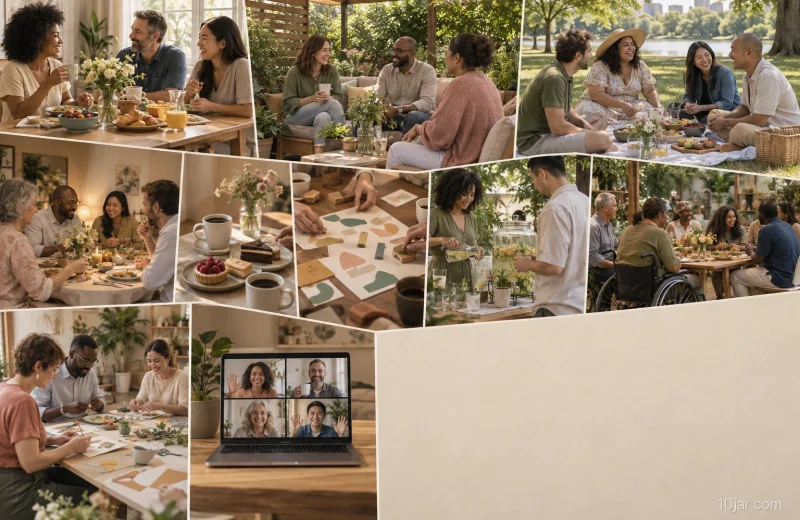


About the author
Emily Parker
Emily Parker covers home, food, and everyday living for 10jar. Her work turns current institutional and safety guidance into practical decision frameworks. Recipe ideas do not imply kitchen testing unless an article explicitly documents it.
Follow 10jar on Pinterest