
How this guide works
Start a Japandi interior design update by clearing one useful surface and choosing a single muted accent. A shallow green tray, a clay-colored cushion or a blue bed cover can give a neutral area direction without filling it with accessories. If you need more storage than the examples show, keep the storage and simplify the visible group around it. The amount of empty space should suit how you use the room.
Decide which space you want to keep available
On a console, it might be the area where you set down a bag. On a desk, it is the part of the top you work at. On shelving, an empty bay can separate objects that would otherwise merge into one display. Identify that useful or visually restful gap before choosing another accessory.
Tate uses composition for the way elements are arranged within art. The practical question here is where your attention goes when a surface contains both a small group and a long open section. Compare the group near the middle and toward one side, keeping everyday items within reach. For a more emphatic approach to shapes and contrast, see the Art Deco interior design ideas.
Work with the furniture’s existing outline
The low console and writing desk offer long straight lines; the sofa and reading chair have fuller rounded outlines. A small tray repeats the horizontal line of a top, while a cushion follows the softer shape of a seat. You can use either relationship without replacing the main piece of furniture.
Tate’s discussion of form includes shape and the physical nature of an artwork. In these rooms, compare the main outline with the smaller shapes above it. A rounded vessel can soften a straight dresser, and a low bowl can echo a rounded table. The mid century modern decor guide offers another way to build around a clear furniture silhouette.
Choose between a small accent and a broad color area
The olive desk tray occupies only part of the top. The rust dining runner draws a longer horizontal line. The blue bed cover fills much of the view. These choices ask for different levels of commitment: try a cushion or tray when you want a small change, and bedding when you want the color to define the room more strongly.
Tate describes proportion through the relationship between parts. Compare the color area with the furniture around it, rather than judging the shade on its own. A muted color can still dominate when it covers a large area. Check a textile beside your existing upholstery or furniture in the room’s usual light before choosing the larger version.
Group a few objects without making every gap identical
The dresser places three vessels together in a shallow tray. The shelf spreads four ochre forms around a broad empty center. The dining table takes a third approach, pairing two small matching forms around a bowl. Choose the grouping that fits the objects you use or want to see; the pictured counts are starting points, not a shopping list.
Keep a tray available for everyday items if it serves as a landing place. Let the shelf’s center stay empty only if the other bays meet your storage needs. A repeated color can link objects of different shapes without requiring a matching set. If you prefer closer left-and-right pairings, compare the traditional interior design ideas.
Judge the gaps from your normal viewpoint
Tate explains perspective in terms of showing three-dimensional space on a flat picture. A wide photograph can make a room look emptier than it feels from a nearby chair. Check your edited surface while standing at the doorway and while using the adjacent seat or desk. Keep the objects you reach for comfortably accessible.
Choose the console or desk for a small green accent, the bed for a larger blue textile, or the shelf when you want to display several related forms. For seating, begin with one warm cushion and assess the change before adding a second. Leave the room ready for its ordinary tasks; a pleasing gap is most useful when it also lets the space work.
On this page
- An empty green tray beside two pale console vessels
- Clay cushions around an open sofa seat
- A rust runner with a centered bowl and paired forms
- Three vessels gathered on a dark dresser
- A muted blue cover with simple bedside surfaces
- Ochre shelf shapes around a broad empty bay
- A terracotta cushion in a low rounded chair
- An olive desk tray with room left for work
- A rose throw across a rounded bench
- Muted teal cushions within a pale seating group
1An empty green tray beside two pale console vessels
A long warm-brown console holds a shallow olive-green tray with two pale rounded vessels beside it. The vessels differ in size, giving the small group height while the tray stays low and empty. Broad stretches of the top remain clear at both ends. This is a useful starting point for an entry surface that needs a place for daily items. Keep the tray for those items, then decide whether one or both vessels earn the remaining display space. The open wall above helps the low horizontal line remain visible.
- Why it works
- The low green tray sits beside a taller pair while long console ends remain bare.
- Best for
- An entry console that can combine a practical tray with a small display.
- Check first
- Keep the green tray useful for the items you bring home.
2Clay cushions around an open sofa seat
A pale sofa curves gently into rounded arms, with one muted clay cushion near each end. The continuous center seat stays clear. In front, a dark low round table carries a single shallow bowl. The warm cushions bring a little color to the sofa without changing the pale outline; the darker table adds a separate point of contrast. Try the two cushions on your existing sofa and use the center as you normally would. Keep a table surface available for everyday needs rather than treating the bowl as essential.
- Why it works
- Warm cushions repeat at the ends of one continuous pale seat.
- Best for
- A pale sofa that needs a small warm accent without extra layers.
- Check first
- Leave the sofa center available when positioning the two cushions.
3A rust runner with a centered bowl and paired forms
A rust-colored runner lies along a pale rectangular table, carrying a central bowl and two small matching rounded forms. The forms sit on opposite sides of the bowl, giving the display an even rhythm. Rounded chair backs soften the table's straight edges. The runner provides most of the color, so the three pale objects can remain simple. Test the runner by itself before adding the full group. If you dine here daily, choose objects that are easy to lift away and leave the places you need for meals.
- Why it works
- A long muted color band connects the bowl and its two smaller companions.
- Best for
- A dining table where a runner can supply most of the color.
- Check first
- Make the tabletop display easy to move away before meals.
4Three vessels gathered on a dark dresser
A long charcoal dresser supports a small round sage tray. A tall pale vessel sits toward the left, a shorter darker one to the right, and a small pale vessel at the front. Their overlapping arrangement creates a compact group above the wide horizontal drawer fronts. Much of the top remains available on both sides. Try this when you have a few vessels with related shapes but different sizes. Check the grouping from the side as well as the front, reducing the number if it starts to look crowded.
- Why it works
- Overlapping rounded vessels contrast with the dresser's long straight drawer fronts.
- Best for
- A wide dark dresser with room for one compact group.
- Check first
- The smallest vessel sits at the front of the tray group.
5A muted blue cover with simple bedside surfaces
A blue cover spreads across a low bed beneath two pale pillows and a sand-colored rectangular headboard. Dark brown bedside tables give the pale room two compact areas of contrast. Their tops are empty in the example, keeping attention on the broad blue textile. Choose this direction if you want color without several small decorative objects. Use the bedside surfaces for what you actually need, then keep the remaining arrangement simple. If blue feels too dominant at this scale, compare a narrower folded cover at the foot first.
- Why it works
- A single broad blue area becomes the main color choice.
- Best for
- A bedroom where bedding can carry the main color accent.
- Check first
- Add everyday bedside necessities without repeating decorative objects on both sides.
Quick comparison: all 10 ideas
Swipe or scroll horizontally to compare every column.
| Design Direction | Room Area | Light Area | Deeper Tone | Main Outline | Muted Accent | Visible Grouping | Useful Space |
|---|---|---|---|---|---|---|---|
| An empty green tray beside two pale console vessels | Console | Pale wall and vessels | Warm brown console | Long horizontal top | Olive-green tray | Empty tray beside two vessels | Keep useful space at both ends |
| Clay cushions around an open sofa seat | Sofa | Pale upholstery and rug | Dark low round table | Rounded sofa and bowl | Two clay cushions | Cushions at ends; bowl on table | Leave the center seat available |
| A rust runner with a centered bowl and paired forms | Dining table | Pale table and chairs | Warm floor and rug | Straight table; rounded chair backs | Rust runner | Bowl between two matching forms | Allow space for everyday dining |
| Three vessels gathered on a dark dresser | Dresser | Pale wall and two vessels | Charcoal drawers | Long drawers; rounded tray group | Sage tray | Three vessels at different heights | Retain usable surface on both sides |
| A muted blue cover with simple bedside surfaces | Bed | Pale pillows and sand headboard | Dark brown bedside tables | Low rectangular bed and tables | Muted blue cover | Two pillows above broad cover | Use bedside tops for real needs |
| Ochre shelf shapes around a broad empty bay | Shelf | Pale frame and wall | Shadows within compartments | Asymmetric shelf with broad central gap | Four ochre forms | Two forms left; bowl and bottle right | Reserve an open bay if storage allows |
| A terracotta cushion in a low rounded chair | Reading chair | Pale rounded upholstery | Dark floor vessel | Low curved seat and back | Terracotta cushion | Two books beside floor vessel | Keep nearby items easy to reach |
| An olive desk tray with room left for work | Desk | Pale wall, books and vessel | Warm brown desktop | Slender straight desk legs | Olive tray | Tray left; books middle; vessel right | Preserve working depth along the front |
| A rose throw across a rounded bench | Bench | Pale upholstery and large cushion | Dark recessed base | Long seat with rounded ends | Rose cushion and throw | Two cushions left; throw right | Keep enough seat length to sit |
| Muted teal cushions within a pale seating group | Seating group | Pale upholstery and walls | Warm brown seat frames | Sofa and two matching armchairs | Two teal sofa cushions | Bowl and vase on rear ledge | Adapt the center for everyday movement |
6Ochre shelf shapes around a broad empty bay
Four ochre objects occupy different parts of a pale asymmetric shelf: an irregular rounded vase at the upper left, a small round form below it, a raised bowl at the upper right and a bottle-shaped vessel underneath. A wide middle bay remains empty. Their shared color connects the separated shapes without filling the center. This works as a display idea when storage is available elsewhere. If the shelf also holds everyday things, reserve one visible open bay and group the practical items in the remaining compartments.
- Why it works
- A common ochre tone links four shapes across separated shelf areas.
- Best for
- Open shelving with enough storage elsewhere to leave a bay unused.
- Check first
- The four forms sit at different levels around the open middle.
7A terracotta cushion in a low rounded chair
A terracotta cushion sits against a low pale chair with a rounded back and seat. Two pale books and a dark vessel are grouped on the floor to its right. The cushion carries the warm color while the vessel supplies a small dark counterpoint. The useful detail to borrow is the cushion against the quiet upholstery. Keep books where you can reach them easily, using a nearby existing surface if a floor arrangement would be inconvenient. Let the curve of the chair remain visible around the textile.
- Why it works
- The warm cushion stands out against pale upholstery and a small dark vessel.
- Best for
- A rounded chair whose silhouette can stay clear beside one cushion.
- Check first
- The books and vessel are pictured on the floor beside the chair.
8An olive desk tray with room left for work
A slender brown desk has three separate elements along the back of its top: an empty olive tray on the left, two pale books near the middle, and a pale vessel on the right. The front area remains clear. The tray gives a small, contained color accent while the books and vessel vary the height across the surface. Compare this with the tools and papers your work actually requires. Use the tray for small working items, and remove the vase if it reduces the usable depth of the desk.
- Why it works
- Three separate groups leave a clear working area along the front.
- Best for
- A work surface where a shallow tray can organize smaller items.
- Check first
- The books and vase sit separately from the empty olive tray.
9A rose throw across a rounded bench
A long pale bench has rounded ends above a dark recessed base. Two cushions sit toward the left, one large and pale and the other smaller and rose-colored. A rose throw drapes over the right side, with its fringe crossing the front edge. The repeated color links the separated textile groups while much of the seat stays visible between them. Try the cushion first, then add the throw only if you use it. Fold it more narrowly when it takes up a seat you need.
- Why it works
- Rose repeats across the bench while the curved pale seat remains visible.
- Best for
- A bench with enough seat length for textiles and everyday sitting.
- Check first
- The throw covers the front edge at the right end.
10Muted teal cushions within a pale seating group
A pale sofa sits behind two matching armchairs with warm-brown frames. Two muted teal cushions remain on the sofa, leaving the chairs plain. A low bowl and tall pale vase are separated along the wall ledge behind the seating. The furniture shares a similar upholstery tone, while the frames and cushions supply smaller contrasts. If your seats do not match, try linking them with one common textile color. Keep the center suited to conversation and movement; the pictured open floor is a choice to adapt to your room.
- Why it works
- Teal stays on the sofa while similar pale upholstery connects all three seats.
- Best for
- A seating area whose upholstery or frames can provide a shared visual link.
- Check first
- The bowl and vase sit on the rear ledge, above the sofa.
Frequently asked questions
Can I keep the useful things on my bedside table?
Yes. Start with the items you use each day and simplify around them. The pictured empty tops make the blue bedding easy to notice, but you can get a similar balance by keeping decorative extras to a minimum. There is no need to make both sides identical if the two users need different things.
How can an open shelf work when I need storage?
Keep the storage you need and choose one bay to leave open if space allows. Group everyday items within the other compartments, then compare the shelf from across the room. If an empty bay is impractical, reduce the number of separate decorative objects instead of removing useful storage.
Does a muted color have to be used only in a small amount?
No. The blue bed cover shows a muted shade across a broad area, while the green trays use it in a smaller patch. Choose the larger textile when you want the accent to lead the room. Begin with a smaller cushion or folded throw if you want to test the shade beside your existing furniture.
Do I need matching vases for a quiet-looking group?
The dresser uses different sizes and slightly different tones, gathered in one tray. A related rounded shape gives them enough connection. Try the objects you already own together and leave room around the group; matching every vessel is less useful than choosing a clear arrangement at the right scale.
Should I copy the books on the floor in the reading corner?
Borrow the warm cushion and rounded silhouette first. Put reading material wherever it is easiest to reach and keep tidy, whether that is a side table or an existing shelf. The small floor group is a visual option, and you can leave it out when it gets in the way of using the chair.
Related posts
View all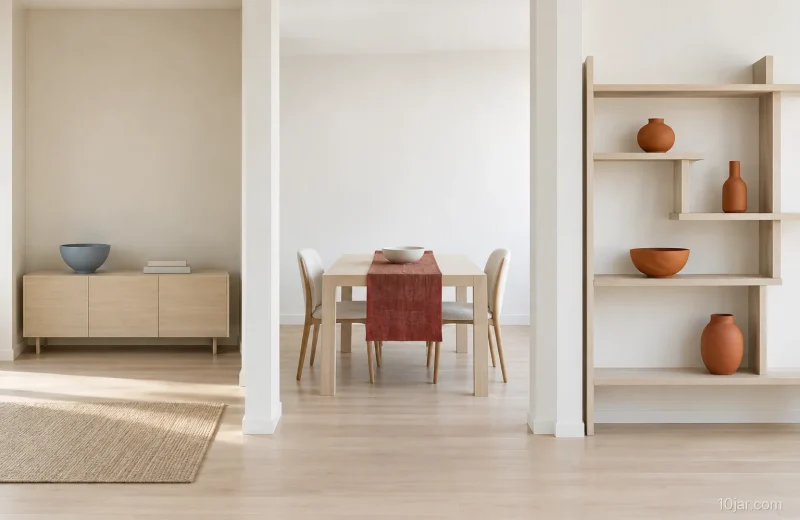

About the author
10jar Editorial Team
The 10jar Editorial Team builds research-led visual decision guides. We document our criteria, cite consequential sources, state what we did not test, and correct material errors when we find them.
Follow 10jar on Pinterest