
How this guide works
Small bedroom ideas work best when the room still feels easy to use at the end of the day. A throw may give the bed all the color it needs. One picture can finish the wall beside a wardrobe. A handsome group of low pieces may be too much if it makes getting dressed awkward. Compare these ten scenes by the decision each one helps you make, then borrow only the part your bedroom needs.
Give the bed a clear visual lead
The bed already occupies a large part of a small bedroom. Choose whether its strongest detail will be the bedding, the headboard wall or the bedside pieces. The blue-panel example puts the emphasis above the pillows. The teal example relies on its throw and rug border while the broad wall behind the bed stays plain. Both approaches give you a place to stop decorating.
Tate describes composition through the arrangement of elements in an artwork. Apply that idea when deciding which detail gets attention and which surroundings stay quieter. For more choices about coordinating an existing bed, wall and textiles, see the bedroom decor guide.
Look at the room from the door and from the bed
An accent visible from the doorway may sit outside your usual view when you are in bed. The olive pair beside the door answers that second view, while the cranberry scheme connects a curtain and dresser across the closed closet front. Compare both positions before committing to a whole set of new decorations.
Tate’s perspective concerns representing three-dimensional space on a two-dimensional picture surface. That distinction matters when reading these scenes: the visible floor is not a measurement. Check the real route to the bed and wardrobe with doors and drawers open as needed. A pleasing photograph alone cannot tell you whether furniture will fit.
Let the usable wall set the size of the display
A tall strip beside a wardrobe calls for a different display from a wide headboard wall. The stacked olive-and-grid pair takes a narrow vertical direction; the three panels over the blue bed spread horizontally. You can keep the relationship while reducing the display to one piece. Check the actual wall and any mounting requirements before choosing artwork.
Tate explains proportion in terms of relationships between parts of a whole. Compare the artwork with the furniture and openings around it, rather than assuming that a pictured size will transfer to your bedroom. The bedroom wall decor guide offers more wall-focused directions once you know which area is available.
Decide which objects deserve floor space
The rust bedside cabinets provide a specific furniture idea; the three shapes near the dresser provide a shape-and-color comparison. They need different decisions. Ask whether a piece will serve an actual daily purpose and whether its intended use suits that purpose. If the answer is unclear, take the palette from the image and leave the extra object out.
Tate’s definition of form includes physical nature and shape. A cylinder, a rectangular block and a flat wall panel can repeat a color while taking up very different amounts of room. Rounded corners in an image do not prove that a piece is a seat, a storage container or a suitable bedside table. Use the real product information for those decisions.
Test a bedroom change through an ordinary routine
Run through opening the door, getting into bed, reaching your belongings and getting dressed. If a desk is present, include sitting down and moving the chair. The blue desk scene is a decorating reference for an existing workspace; its pictured spacing does not establish your chair clearance or a complete working setup.
Reduce the decoration if it makes any of those tasks harder. You might keep a matching curtain and throw, choose one cabinet instead of two, or leave the wall beside the dresser empty. The wider small apartment guide helps connect the bedroom palette with other areas when the room itself is settled. Finish with a useful bedroom, even if that means using fewer elements than the scene shows.
On this page
- A gridded entry picture with teal blocks
- Two rust cabinets on one bedside wall
- Three panels balancing blue with beige
- A yellow circle echoed in soft bedding
- A stacked pair beside the wardrobe
- A blue accent for an existing desk corner
- Teal bedside pieces with a quiet headboard wall
- One rounded form between two pale blocks
- Cranberry textiles around a pale closet front
- Olive and grid panels in the bed-to-door view
1A gridded entry picture with teal blocks
A framed pale grid picture contains a large teal rectangle and a smaller beige rectangle. Below it, a low teal upholstered bench repeats the main color beside the open wood door. The foreground bed carries a teal throw, making the doorway view feel related to the sleeping area. The picture-and-throw pairing can be enough on its own. Add a bench only when it has a useful purpose and fits the actual entry space; check the door movement and your everyday approach to the bed.
- Why it works
- The artwork contains its own unequal teal-and-beige shapes inside a larger grid.
- Best for
- A bedroom entry with an available wall beside the door.
- Check first
- Keep the bench optional and check the real entry route.
2Two rust cabinets on one bedside wall
Two small rust-colored two-drawer cabinets sit side by side on the same side of the bed. Narrow vertical ribs run behind them, while rust bedding and a striped cushion repeat the warm accent. The pair makes a longer low line than one bedside cabinet would. In a compact room, start by deciding what you need within reach at night. One suitable cabinet may do that job without taking up the space of the full pair. Check access to its drawers and the nearby bed.
- Why it works
- Two drawer units form one longer rust band beside the bed.
- Best for
- A bedside wall where suitable drawer storage is actually needed.
- Check first
- One cabinet can be enough; check the drawers in use.
3Three panels balancing blue with beige
Three equal upright wall panels sit above a pale headboard: one plain beige, one beige check and one plain blue. Two blue pillows and a blue throw carry the accent down onto the bed, with a checked cushion between the pillows. The mix of plain and patterned panels gives the wall variety without needing three different colors. Borrow the blue-and-beige bedding first if the wall is already finished. If adding artwork, assess its real size and mounting requirements separately from the balanced appearance of the scene.
- Why it works
- A checked middle panel bridges the plain beige and blue panels.
- Best for
- An existing pale bed with room for a modest overhead display.
- Check first
- Choose the bedding link before committing to new mounted artwork.
4A yellow circle echoed in soft bedding
A large yellow circle sits behind the bed, with a smaller yellow dot to its right. Three closed cylindrical forms of different heights stand near the window in pale, taupe and yellow tones. A yellow lumbar cushion and checked throw repeat the scheme on the bed. The circular shapes offer a softer counterpart to the window lines, but the complete floor group is optional. A yellow cushion with an existing neutral throw can carry the idea when the window corner needs to remain available.
- Why it works
- One large circle and a small dot relate to rounded low forms.
- Best for
- A bedroom whose existing neutral textiles could use a yellow accent.
- Check first
- Borrow the cushion color if the three floor forms are unnecessary.
5A stacked pair beside the wardrobe
A tall pale grid panel hangs above a smaller plain olive panel on the narrow wall beside the wardrobe. An olive throw repeats the accent across the foreground bed, while the wardrobe fronts remain pale. Stacking the two works uses the vertical strip without spreading across the storage doors. Check the actual wardrobe in use before choosing the display size. A single narrow picture and the bedding accent can be a complete version of this idea if the available wall is smaller than the one shown.
- Why it works
- An unequal vertical pair uses the narrow wall beside storage.
- Best for
- A bedroom with a narrow exposed wall beside its wardrobe.
- Check first
- Check wardrobe use before choosing artwork for the adjacent strip.
Quick comparison: all 10 ideas
Swipe or scroll horizontally to compare every column.
| Design Direction | Bedroom Area | Main Feature | Pattern Cue | Accent | Visible Group | Space To Check | Smaller Version |
|---|---|---|---|---|---|---|---|
| A gridded entry picture with teal blocks | Entry side | Grid artwork | Contained rectangles | Teal | One picture and low bench | Door approach | Keep picture and bedding |
| Two rust cabinets on one bedside wall | Bedside wall | Rust cabinet band | Narrow wall ribs | Rust | Two drawer cabinets | Bed and drawer access | Use one cabinet if sufficient |
| Three panels balancing blue with beige | Headboard wall | Three upright panels | Central beige check | Blue | Three panels and bedding | Actual mounting position | Start with blue textiles |
| A yellow circle echoed in soft bedding | Window side | Large wall circle | Small dot and checked throw | Yellow | Three cylinders and two wall circles | Window corner | Borrow one cushion color |
| A stacked pair beside the wardrobe | Wardrobe edge | Unequal stacked pair | Tall pale grid | Olive | Two panels and bed throw | Wardrobe doors in use | Reduce to one narrow picture |
| A blue accent for an existing desk corner | Desk corner | Blue wall field | Pale ribs and striped throw | Blue | Desk, blue chair and wall panel | Chair and bed access | Use an existing blue accessory |
| Teal bedside pieces with a quiet headboard wall | Bed surround | Teal textile group | Dotted rug with border | Teal | Two bedside units and bedding | Both sides of bed | Keep the bedding emphasis |
| One rounded form between two pale blocks | Dresser side | One rounded accent | Fine neutral rug grid | Rust | Cylinder and two pale blocks | Dresser and bed route | Leave low group out |
| Cranberry textiles around a pale closet front | Closet-facing view | Quiet central doors | Checked bedding | Cranberry | Curtain, dresser and throw | Closet door opening | Coordinate textiles first |
| Olive and grid panels in the bed-to-door view | Door-facing wall | Small stacked display | Lower panel grid | Olive | Two panels and existing textiles | Route from bed to door | Choose one distant artwork |
6A blue accent for an existing desk corner
A wood-toned desk with a pale drawer unit sits against a ribbed wall and a plain blue panel. A blue chair repeats the accent; one thin flat object lies on the desktop. Blue pillows and a striped throw connect the work corner to the bed nearby. The helpful decorating move is the color link between areas already in use. Check the real chair position, desk needs and bed access first. Keep the color on one existing accessory if more wall treatment would add an unnecessary project.
- Why it works
- Blue appears on the wall, chair and bedding across two existing areas.
- Best for
- An established bedroom workspace that already has suitable desk furniture.
- Check first
- Assess the actual desk setup and chair movement independently.
7Teal bedside pieces with a quiet headboard wall
Two teal cube-like bedside units flank the bed, matching two teal pillows and a deep teal throw. Small teal marks and a teal border on the rug extend the palette onto the floor, while the wall above the headboard is blank. The arrangement shows how bedding and bedside pieces can finish a room without another wall display. Start with the textiles you use most. Keep only the bedside furniture that suits your needs, and assess bed access and any rug separately in the actual room.
- Why it works
- The rug border and bedding carry the decoration below a blank wall.
- Best for
- A room where bedding can provide the main decorative emphasis.
- Check first
- Keep the number of bedside pieces tied to everyday use.
8One rounded form between two pale blocks
A rust-colored upholstered cylinder sits between a taller pale block and a lower long pale block against an empty wall. The bed at the left repeats rust in its throw and checked pillow, while a wood dresser stands at the right. The useful comparison is the single warm rounded shape among quieter rectangular forms. You can borrow that contrast through bedding alone. Do not add three low pieces simply to fill the wall; leave the space available if it helps you use the dresser and bed.
- Why it works
- One rust cylinder breaks up the straight lines of two pale blocks.
- Best for
- A bedroom that needs a warm accent without more wall art.
- Check first
- Retain the palette while omitting low objects without a purpose.
9Cranberry textiles around a pale closet front
A pair of pale closet doors forms the center of the view from the bed. A cranberry curtain at the window, a matching dresser and a cranberry throw carry the color around that quiet middle. Checked bedding adds a smaller repeat without changing the door fronts. This is a useful direction when an existing closet occupies much of the wall you see most. Try the curtain-and-throw relationship first, and check the real closet with its doors open before deciding whether nearby furniture can stay where it is.
- Why it works
- A pale closet front gives the cranberry accents a quiet center.
- Best for
- A bedroom where closet doors dominate the view from the bed.
- Check first
- Check closet doors open, not only the closed-door appearance.
10Olive and grid panels in the bed-to-door view
A plain olive panel hangs above a pale grid panel beside the bedroom door. Olive curtains, a throw and a cushion connect that small wall display to the bed by the window. The larger stretch of wall between them stays empty, giving the separate accents room to read. Use the view from the bed to choose a single detail worth seeing across the room. One picture can replace the pair, and existing olive bedding can make the connection without adding anything along the route to the door.
- Why it works
- Two small stacked works connect with larger olive textiles across the room.
- Best for
- A sleeping space with a clear view toward the bedroom door.
- Check first
- One small artwork can finish the distant view without a pair.
Frequently asked questions
Where should I start decorating a small bedroom?
Choose the part of the bed you want to emphasize: bedding, the headboard wall or nearby furniture. Try a useful textile change first if it gives you the color you want without adding another object.
Do both sides of a small bed need matching furniture?
Let the real space and your daily needs decide. The teal scene shows a matching pair, while the rust scene groups two cabinets on one side. Neither arrangement is a requirement; one suitable piece may be enough.
What should I check before putting a desk beside the bed?
Check the actual desk and chair dimensions, chair movement, your working setup and the space needed to use the bed. A color-coordinated scene does not demonstrate a complete workspace or the clearances in your room.
How can I decorate a wall mostly occupied by closet doors?
You can leave the door fronts quiet and connect existing textiles elsewhere in the room, as the cranberry curtain and throw do. Check the doors in use before adding nearby furniture, and use any remaining wall only if it is suitable.
Can a small bedroom look finished without much wall art?
Yes. The teal bedding, bedside pieces and bordered rug provide a clear visual relationship while the broad headboard wall stays blank. You can use fewer of those elements and still give the room one consistent accent.
Related posts
View all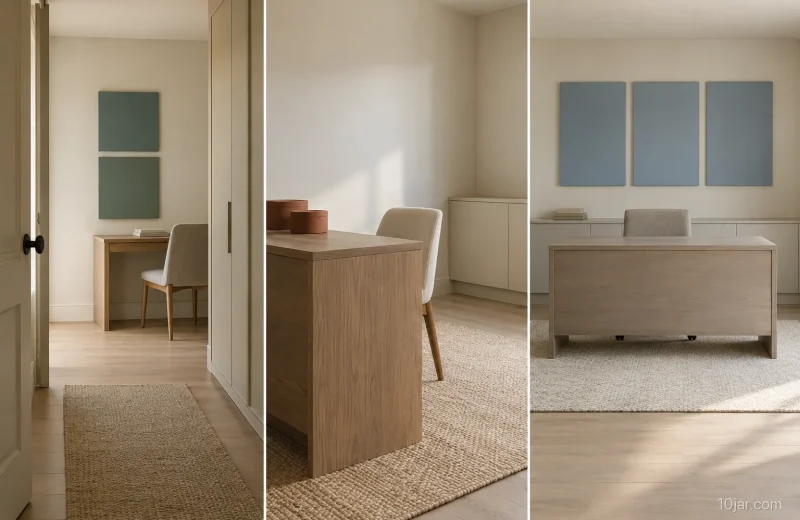

About the author
10jar Editorial Team
The 10jar Editorial Team builds research-led visual decision guides. We document our criteria, cite consequential sources, state what we did not test, and correct material errors when we find them.
Follow 10jar on Pinterest