
How this guide works
Start coastal bedroom ideas with the room’s largest visible surface: usually the bed. A plain cover, one sea-colored accent and a useful texture can establish the direction before you replace furniture or add beach-themed ornaments.
The ten ideas below work as individual changes. Choose the layer your room is missing, try it with something you already own, and stop when the bedroom feels finished to you. A room with a striking bed may need quieter textiles; a plain room may benefit from a stripe or a wide piece of art.
Choose the layer, then decide how far to take it
Look from the doorway and name what catches your attention first. Is it a patterned duvet, a dark bed frame, a blank wall or an uncovered window? Work with that feature before adding several smaller accents. The change ladder compares what stays, what changes and the compromise each idea brings.
For a coastal direction throughout the home, see the broader coastal decor guide. Here, the emphasis is on the bedroom’s everyday jobs: making the bed, closing the curtains, setting down a book and keeping spare textiles somewhere useful. You can leave a strong existing piece in place and build around it.
Give texture a job
A woven headboard, a folded cover and a linen basket all add texture, but they ask different things of the room. The headboard is a furniture decision; the cover can be swapped; the basket needs something to hold and a place to stand. Pick the one that solves an actual missing layer.
Check the care instructions on the particular textile before choosing it. A pale cover that suits your laundry routine may be more useful than a dramatic arrangement of cushions you have to move every night. If you are undecided about the coastal direction itself, compare the wider bedroom decor ideas before replacing a large piece.
Let the window work after dark, too
Loose, light curtain folds can be part of the look, but decorative panels are not a reason to discard a working privacy layer. Check what can be seen through the window after dark with the room lights on. Keep a suitable existing shade if the new panels do not provide the privacy you want.
Where young children may be present, CPSC recommends cordless window coverings and keeping beds and other furnishings away from windows and cords. That applies to a guest bedroom as well as an everyday one. Follow the covering and hardware instructions; a decorative photograph cannot establish a safe installation.
Check the palette under the lights you use
Put your proposed textiles beside the existing furniture in daylight, then look again with the normal evening lights on. Notice whether the combination still appeals to you before ordering more pieces in the same color. This is a comparison of your room, not a rule that every coastal bedroom must have identical lighting.
ENERGY STAR describes light color appearance in Kelvin: lower numbers look more yellowish, while higher numbers look whiter or bluer. Use that information when comparing compatible lighting options. It does not tell you one required bedroom setting or whether the light is adequate for reading. Keep changes within the fixture manufacturer’s instructions.
Finish with the room still easy to use
Before adding a rug, basket or chair textile, walk the routes you use and open the doors or drawers beside it. Keep anything you need to put down within the existing useful surfaces. When space is the main constraint, the small bedroom ideas guide gives the larger room context.
Pick one trial from the ladder and live with that change before deciding on the next. Start with the tonal bed if several patterns are competing, the stripe if the room lacks a focal detail, or the window layer if daytime appearance and evening privacy disagree. A headboard replacement can wait until the current one actually needs replacing.
On this page
1Tonal bed foundation
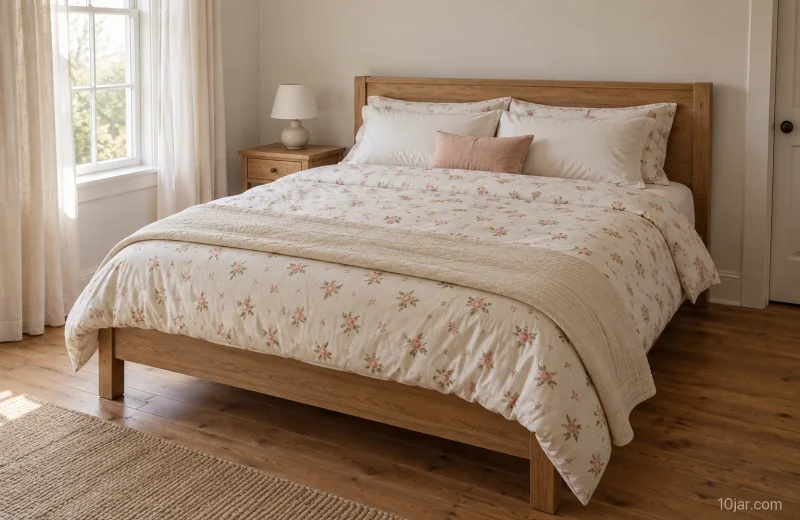
Cover the largest pattern first. Lay a plain cream sheet over a busy duvet for a quick visual trial, then look at the bed from the doorway. If the room feels closer to the coastal direction you wanted, a cream, oat or sand-colored cover may be the only large change needed. Let the surface texture do some of the work: a visible weave or stitched channel can give plain cloth detail without another printed motif. Keep the bed frame and useful bedside furniture in place. The compromise is practical rather than stylistic—a pale cover has to fit your own care routine. Choose the actual material and cleaning instructions you can manage, and leave additional decorative cushions until the main bed surface works.
- Why it works
- A large plain surface gives the existing furniture room to remain part of the scheme.
- Best for
- A bedroom where several bedding patterns currently compete.
- Check first
- Try the visual change with an existing sheet before selecting a new cover.
2A single stripe
A broad faded-blue stripe can provide the graphic detail a plain room is missing. Keep it to a throw folded across the foot of the bed, with the main cover left simple. From the doorway, the band should be easy to notice without needing matching striped curtains, cushions and a rug. Test the idea by folding an existing striped textile so only a limited area shows. A fine ticking stripe gives a quieter result than a wide band; choose by how much attention you want it to take. This is a small, reversible way to try the look. If your bedcover is already strongly patterned, use the tonal foundation first rather than add another competing print.
- Why it works
- One controlled band of pattern gives plain bedding a clear focal detail.
- Best for
- A mostly plain bedroom that needs a small graphic accent.
- Check first
- The stripe need not appear anywhere else in the room.
3Dark wood with pale layers
Keep the dark bed. Its deeper finish can be part of a coastal bedroom when the surrounding cloth is pale and the accents are restrained. Try oat bedding against the actual wood, then add a muted blue textile if you want a sea-colored note. There is no need to paint every bedside piece white or replace a useful matching dresser. Leave some of the dark frame visible so the contrast feels intentional. The room will still have a substantial dark feature; this choice will not turn it into an all-white space. If that is what you want, compare the cost and effort of a larger change separately. Begin with the textiles so you can judge whether the furniture was really the problem.
- Why it works
- The existing dark finish becomes the contrast instead of an item to remove.
- Best for
- Someone who likes their dark furniture but wants a lighter textile palette.
- Check first
- Judge samples beside the real wood finish, not a screen image of a similar room.
4A horizon on the dresser wall
Give the coastal reference one place to live. A wide abstract landscape with a low horizon can take the place of several small beach-themed ornaments on or around the dresser. Keep the useful part of the dresser top available rather than rebuild the same clutter underneath the artwork. Start with a paper mockup of the proposed size and view it from the room entrance. Then consider how the image relates to the dresser and the rest of the wall. Use an existing suitable fixing or have the mounting assessed; this is an artwork choice, not a hanging tutorial. The artwork may be more immediately coastal than a plain textile, so it can carry the theme while the bedding stays neutral.
- Why it works
- A single broad image gives the coastal reference a defined home.
- Best for
- A bedroom where small themed ornaments have started to accumulate.
- Check first
- Check the wall, frame weight and fixing requirements before changing mounted art.
5Woven texture at the headboard
Consider a woven headboard when the bed already needs a replacement component. Close-woven cane or rattan texture can become the room's main material feature, supported by plain bedding and a relatively quiet wall. It is a larger commitment than a basket or throw, so compare a sample or a detailed material view before deciding. Check compatibility with the actual bed and follow the furniture maker's assembly requirements. Avoid adding several more woven pieces merely because the headboard has introduced that texture. A bedside table you already own may be a better companion than a coordinated set. If the current headboard is sound and useful, keep this as a later option and try the same textural direction in a removable textile first.
- Why it works
- One substantial woven surface can carry the room's material character.
- Best for
- A planned bed update where a textured headboard is already under consideration.
- Check first
- Treat it as a furniture decision, with compatibility and care to check.
Quick comparison: all 10 ideas
Swipe or scroll horizontally to compare every column.
| Layer | Room Problem | Coastal Cue | Keep | Change | Commitment | Tradeoff | First Trial |
|---|---|---|---|---|---|---|---|
| Tonal bed foundation | The bed already carries several competing patterns | Cream and sand with visible weave | Current bed frame | A plain cover over the main bed area | Textile swap | Pale fabric needs a workable care routine | Lay a plain sheet over the patterned cover |
| A single stripe | A plain room needs one graphic detail | Broad faded-blue ticking | Plain main bedding | One striped throw across the bed | Small textile swap | Repeating stripes everywhere makes them the theme | Fold an existing striped textile at the foot |
| Dark wood with pale layers | Existing dark furniture seems at odds with a beach palette | Deep wood against pale cloth | Dark bed and bedside furniture | Oat bedding and a muted-blue accent | Styling only | Dark wood stays visually prominent | Compare pale textiles beside the actual finish |
| A horizon on the dresser wall | Small coastal ornaments compete for attention | One wide abstract horizon | Useful dresser surface | One simple landscape artwork on an existing suitable fixing | Art replacement | Wall suitability still matters | View a paper-size mockup from the doorway |
| Woven texture at the headboard | The room lacks a strong material feature | Close-woven cane or rattan texture | Plain bedding and wall | One compatible woven headboard when replacement is already needed | Furniture decision | More costly and harder to reverse than a textile | Compare a material sample before replacing anything |
| Curtains with a separate privacy layer | Airy-looking curtains do not serve every time of day | Soft off-white folds | Existing suitable shade | Plain curtain panels on suitable existing hardware | Window textile change | Sheer fabric alone may not provide privacy | Check the window from outside after dark |
| An evening light check | Daytime fabric choices look different after dark | Consistent warm-looking light | Safe compatible existing fixtures | Bulb color appearance only if needed and compatible | Lighting check | Appearance does not prove adequate task light | Compare textiles with the normal evening lights on |
| A floor-level stripe | The bed is already simple and the floor looks bare | Flat blue-and-oat banding | Plain bedcover | A suitable flatwoven rug | Floor textile decision | Extra texture adds care and can crowd a small room | Mark the proposed footprint without blocking routes |
| A useful woven basket | Spare textiles collect on the chair | Natural woven texture | Clear bedside surfaces | One appropriately sized linen basket | Small storage change | A basket that overflows is still clutter | Fit only the textiles that will actually live there |
| A chair that belongs to the room | An existing chair feels separate from the bed | One repeated cloth or color | Existing chair and its useful surface | A matching textile note between chair and bed | Finishing layer | Too much matching can feel like a set | Borrow one textile from the bed for the chair |
6Curtains with a separate privacy layer
Soft off-white curtain panels can add movement and texture around a window while a suitable existing shade handles the job the panels cannot. Try the arrangement in both its open daytime position and its closed evening position. The important question is not whether the fabric looks airy in a photograph, but whether you can still use the window as you need to. Check the view from outside after dark with the lights on; sheer material alone may leave more visible than expected. Keep fabric, furniture and coverings clear of their operating paths, and use suitable existing hardware rather than improvise a new mounting. In a room children may enter, choose the cordless arrangement described in the window guidance above.
- Why it works
- The decorative fabric and the practical privacy layer have separate jobs.
- Best for
- A room where the existing shade works but the window needs softer visual texture.
- Check first
- Do not assume a light-looking panel provides the privacy you want after dark.
7An evening light check
Before adding another blue accessory, look at the room when you actually use it after dark. Switch on the normal lamps and compare the bedcover, curtain and furniture finish together. If one lamp looks noticeably different from the other, check the light-color information on compatible replacements rather than judge by the shade or lamp base. The Kelvin explanation above can help you compare the emitted color; it does not set a universal target. Keep useful lighting for the activities you do in the room, including reading if that is part of your evening. This idea may end with no purchase at all: you might simply discover that the textile combination you liked in daylight still works under the lamps you have.
- Why it works
- An evening comparison checks the whole palette before more objects are added.
- Best for
- A bedroom whose daytime and evening appearance feel noticeably different.
- Check first
- Color appearance and adequate light for a task are separate checks.
8A floor-level stripe
Move the pattern to the floor when you want the bed to stay quiet. A flatwoven rug with blue-and-oat bands can give the room a coastal graphic note without introducing a second patterned bed layer. Mark out the proposed footprint first and walk the bed-to-door route. Open nearby wardrobe doors and drawers, and check the rug's actual edge, backing and care requirements before choosing it. A small room may already have enough texture or may not benefit from another floor covering. In that case, leave the floor as it is and try the striped throw instead. These are two alternative places for a strong stripe; they do not have to be used together.
- Why it works
- The main pattern sits beneath the furniture while bedding remains plain.
- Best for
- A bedroom with a simple bed and room for a suitable floor textile.
- Check first
- Check the real rug and walking routes rather than rely on a staged footprint.
9A useful woven basket
Give spare bedding a destination before choosing the basket. Gather the throw or clean linen that would otherwise stay on the chair, and see how much room it actually needs. A woven basket can add a natural-texture note while keeping that chair available. Place it where it can be reached without narrowing the usual walking route, and avoid stuffing it until a tall heap spills over the rim. If you have no spare textile to store, you do not need a basket solely to complete the photograph. The useful version has an everyday job and a realistic capacity; the decorative version can become one more object to move around.
- Why it works
- Texture comes from an object that already has something useful to hold.
- Best for
- A bedroom where clean spare textiles have taken over a seat.
- Check first
- Choose the contents and location before choosing the container.
10A chair that belongs to the room
An existing bedroom chair can look connected to the bed without matching it. Borrow a throw or cushion from the bed and try it on the chair, then stand at the doorway again. Repeating one cloth, color or stripe may be enough to make the two areas relate. Keep the chair's usable seat and nearby surface available, and remove the borrowed piece if it makes sitting down a chore. This is a finishing layer rather than a reason to buy a new chair. A different upholstery color can remain; it is the small repeated note that joins the room. Stop before every surface carries the same fabric, especially if the bedding already has a strong coastal pattern.
- Why it works
- A small repeated textile connects two existing areas of the bedroom.
- Best for
- A room with a useful chair that currently feels visually separate from the bed.
- Check first
- Borrow a textile first and keep the seat ready to use.
Frequently asked questions
Must a coastal bedroom be blue and white?
No. Cream, oat and sand can provide the main palette, with texture carrying much of the look. Add a blue or green note only if you like it beside the furniture and fabrics already in the room.
Can dark furniture stay in a coastal bedroom?
Yes. Try pale bedding beside the actual dark finish before deciding to paint or replace it. Keeping some dark wood visible can make the contrast feel intentional, though the room will still have a substantial dark feature.
Which single change should I start with?
Start with the largest feature that is not working for you. A plain bedcover can quiet several competing patterns; a stripe can give a plain bed a focal detail. Try an existing sheet or folded textile before buying anything.
Do sheer curtains give enough privacy?
Do not assume they do. Check the window from outside after dark with the bedroom lights on, and retain a suitable privacy layer when needed. Where young children may be present, use cordless coverings and keep furnishings away from windows and cords.
How do I check bedroom colors after dark?
Compare the proposed textiles beside the existing furniture with your usual evening lamps on. Kelvin information helps compare emitted light color, but it does not set one correct bedroom target or establish that a lamp gives enough light for every activity.
Related posts
View all

About the author
10jar Editorial Team
The 10jar Editorial Team builds research-led visual decision guides. We document our criteria, cite consequential sources, state what we did not test, and correct material errors when we find them.
Follow 10jar on Pinterest